Research and publications
My research examines how public institutions and policy communities are responding to emerging global security challenges and compound risks.
This page features selected work as lead or co-lead author across commissioned analysis, doctoral research, and independent publications. It excludes (obviously) client-internal and confidential work.
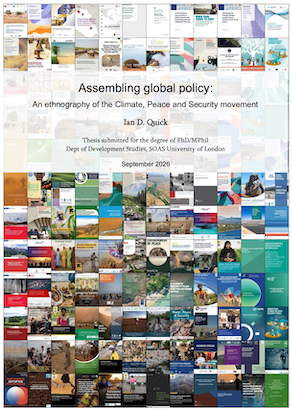
Assembling global policy:
An ethnography of the Climate, Peace and Security movement
SOAS University of London (2026)
My 2026 PhD thesis compared emerging approaches to environmental and climate security across multilateral and bilateral institutions. It draws on close observation of hundreds of decision-makers and senior practitioners over the course of five years.
The findings addressed (i) ideas work that defines links between climate, environment, socio-economic and political phenomena, and (ii) organising work that aligned capabilities and resources around these emerging narratives.
Alongside its immediate policy relevance, the work pioneered new kinds of policy ethnography for “de-bounding” challenges that cut across jurisdictional and institutional boundaries.
Read the thesis abstract →
Summary for Policymakers coming soon.
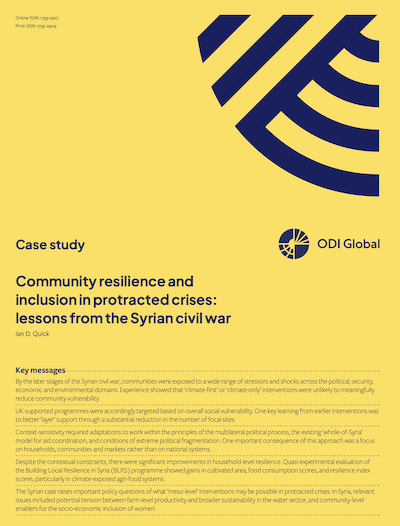
Community resilience & climate action in the Syrian civil war
ODI Global and World Bank Group (2026)
A longitudinal study of the UK’s humanitarian portfolio during the Syrian conflict. It examines opportunities for climate action within / alongside severe political fragmentation and ongoing violence, and how the natural environment fit into the overall landscape of risk for communities. Commissioned for a World Bank synthesis report on the “Peace and Social Dividends of Climate Action”
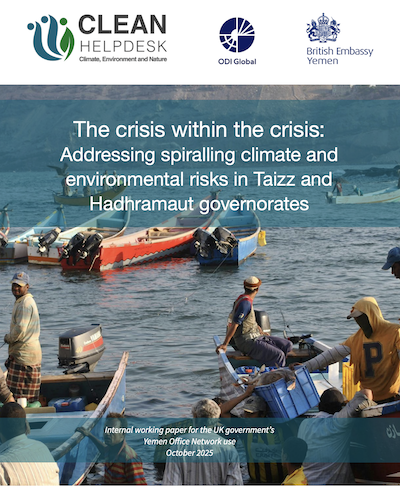
The “crisis within the crisis” in Yemen
CLEAN Helpdesk for UK Foreign, Commonwealth and Development Office (2025)
Co-authored with Yue Cao, Camille Laville and Basile Maupu-Estupina
A detailed review of the interactions between conflict and ecological decline in Yemen, with empirical focus on Taizz and Hadhramaut. It is notable for its systematic approach to the structural drivers of crisis in the water and agri-food sectors; the management and exploitation of scarcity by conflict parties; and the hidden costs of international support to political stabilisation.
Follies in fragile states: How stabilisation failed in the Congo
What has been going wrong in the Democratic Republic of the Congo? Why has the most expensive UN peacekeeping mission in history been unable to end violence after fifteen years of continuous deployment? Why does the country reappear every year, without fail, among the world’s largest appeals for emergency aid?
Follies in Fragile States explores how we got to this point. It is the first inside account of the ‘stabilisation’ effort in eastern Congo from 2007 onwards, cutting through the spin and academic mystification to identify the key decision points and where things went wrong.
The common threads are pulled together as the Five Follies: key respects in which international engagement was simply not fit for purpose. Each is brought to life in policy-makers’ own words, then contrasted with the ground truth of the individuals and communities who would make or break the stabilisation project.
We have brought the book into open-access to mark the 10th anniversary of publication. Hard copy and ebook versions remain available at Amazon and other booksellers.

Independent evaluation of the UN-IFI Partnership Facility
UN Peacebuilding Support Office / Multi-Partner Trust Fund Office (2024)
Co-authored with Sarah Cramer-Smith
Portfolio evaluation for a technical / funding facility that supports collaboration between the UN and international financial institutions in crisis settings. We explored the activation and use of the funding envelopes and processes created under the World Bank’s 2025 Fragility, Conflict and Violence Strategy, along with strategic coherence between the UN’s political / peacebuilding work and broader development strategy.
On failure: Ethics, motivation and public service in extreme situations
One Step Forward podcast and contributors (2022)
There’s a recurring dilemma in working on the toughest public problems. The work is motivating because the stakes are so high, and there’s a prospect of making “a real difference”. But at the same time, clear successes are few and far between.
This long-form essay gathers reflections on success and failure from a dozen practitioners working across humanitarian crises, human rights investigation, and other exceptionally difficult vocations.
Options for Innovative Funding in Support of United Nations Peacebuilding
German Federal Foreign Office (2020)
Co-authored with Pierre Van Hoeylandt and Anne Le More
In 2018 the UN Secretary General called for a “quantum leap” in peacebuilding funding … but it is fair to say that this did not materialise. This report systematically explored options beyond traditional grant funding. Follow-up work focused on peace-positive development finance, and led to the ongoing Investing for Peace initiative supported by the German government.
Implementation & financing of Recovery & Peacebuilding Assessments
United Nations, World Bank and European Union (2017)
Co-authored with Spyros Demetriou
PoOPoPoPortfolio evaluation for Recovery & Peacebuilding Assessments (RPBAs), the peak framework for collaboration between the World Bank, UN and EU in crisis settings. It reviewed implementation across a dozen countries, over a span of nearly twenty years. Findings focused on “what worked” for steering and operational coordination, monitoring and tracking results, and organising funding streams.
Community engagement for UN peace operations
UN Department of Peacekeeping Operations / Department of Field Support (2018)
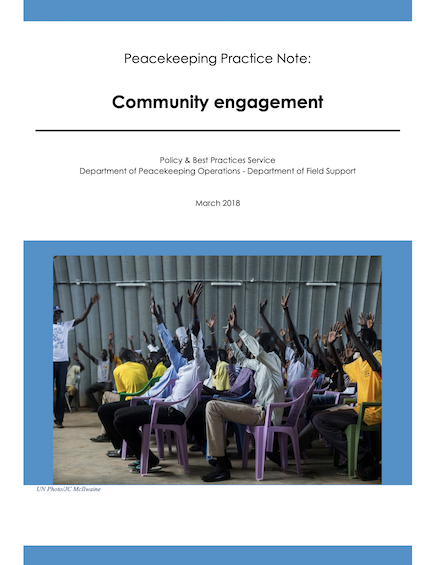
First-generation policy guidance on stronger inclusion of communities within political and peace processes. Drew on an eighteen-month pilot in different regions of the the Central African Republic, and stakeholder engagement across the full portfolio of UN peace operations.
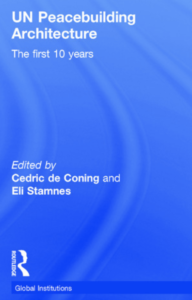
Searching for a niche: the UN in the Republic of Guinea
Routledge Global Institutions (2016)
In ‘UN peacebuilding architecture: the first 10 years’ (eds de Coning and Stamnes)
A post-mortem of the UN’s role in Guinea’s democratic transition – and how the world organisation found itself stuck between the traditional model of government-to-government partnership, and demands to be more inclusive and proactive.
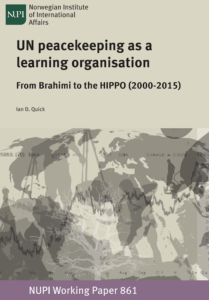
From Brahimi to the HIPPO: UN peacekeeping as a learning organisation
Norwegian Institute of International Affairs (2016)
A longitudinal study of institutional learning within UN peacekeeping, during its period of explosive growth from 2000-15. This period saw rapid development of policy approaches and capabilities for unfamiliar new tasks across a dozen different countries, while under close political scrutiny at all levels. The practical focus was on how to shorten the learning curve for other institutions (notably the African Union).
Redefining Success: New Approaches to Engaging With Fragile States
World Politics Review (2015)
There is a yawning gap between between what we’ve repeatedly said that we would do in fragile states, and the actual results. This long-form article tried to redefine what achievable outcomes could look like, anchored in a careful study of history and geography.
Also appeared as the featured guest on the very first episode of the Trendlines podcast. My exchange with host Peter Dorrie starts at 21:00, with me arguing for a ‘better, more sane approach’ in fragile states (his words!).